 |
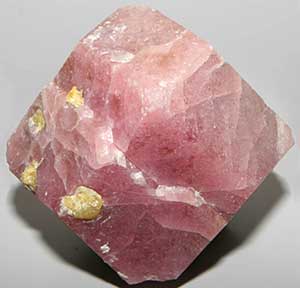
| Grossular Garnet - Ca3Al2(SiO4)3. |
Garnet
"Garnet" is the name given to a group of chemically and physically similar minerals. A very small number of garnets are pure and flawless enough to be cut as gemstones. The majority of garnet mining is for massive garnet that is crushed and used to make abrasives. Garnet is a silica mineral; in other words, garnet's complex chemical formula includes the silicate molecule (SiO4). The different varieties of garnet have different metal ions, such as iron, aluminum, magnesium and chromium. Some varieties also have calcium. Garnets all crystallize in the isometric (meaning equality in dimension. For example, a cube, octahedron, or dodecahedron.) crystal system. Garnets all are quite hard, ranging between 6 and 7.5 on the Moh's hardness scale. They also lack cleavage, so when they break, they fracture into sharp, irregular pieces. The combination of the hardness and fracture make garnet a valuable abrasive material.
Name
The name garnet has been used since ancient times. It was derived from the Latin word granatium which means a pomegranate because small, red garnet crystals were thought to resemble pomegranate seeds. The original name given this mineral group was granat. In time the "r" and "a" were transposed giving us garnet. The name was officially proposed to mineralogists by the German theologian and philosopher, Albertus Magnus.
Sources
In the United States, only a few companies in three states (Idaho, New York, and Montana) produce garnet for industrial use.
There are many significant garnet-producing countries. Noteworthy among them are Australia, China, and India, all of which export significant amounts of garnet. Russia and Turkey also produce large amounts of industrial garnet, but they are not yet exporting much of this material.
Uses
Garnet is ground to a variety of sizes to be used as an abrasive. Garnet sandpaper was the original application of this mineral. It is also used to make a number of similar products, including sanding belts, discs, and strips. Today, the vast majority of garnet is used as an abrasive blasting material, for water filtration, in a process called water jet cutting, and to make abrasive powders.
Substitutes and Alternative Sources
A number of natural and synthetic materials could be used in place of garnet for abrasive purposes. The natural materials include the minerals staurolite, quartz, diamond and corundum. The synthetic materials include fused aluminum oxide and silicon carbide.
(Information adapted from "Minerals in Your World", a cooperative effort betweeen the U.S.
Geological Survey and the Mineral Information Institute.)
Copyright © 2003-2010 Calvin & Rosanna Hamilton. All rights reserved.